Britain’s rail stations: The ring of confidence
Here, Mike shares insights from the Station Summit, setting out why station success in 2035 relies on a more confident, informed and collaborative industry.


This week, I had the pleasure of participating in the Railway Delivery Group’s annual Station Summit. It was a good gathering of industry colleagues involved in the management and development of Britain’s railway estates.
As a panellist on “The Future of the Station”, I was asked what station success would look like in 2035. Rather than focus on the physical attributes and experience of a station for a user, I set a bigger ambition. I argued that success could be defined by an industry whose approach to stations was more confident than it is today.
Today’s station estate
The 2,585 stations on Britain’s railway network have a special place in our culture and society. It is a unique estate in terms of its scale and role. That uniqueness is also not uniform – we have a wide variety of stations in terms of their form, condition, context and use.
Our management of the estate has also been equally varied over time. We have seen positive contributions from the New Stations Fund, National Station Improvement Programme, Access for All, and even Modern Facilities at Stations programmes. We have also seen local stakeholders fund enhancements and new stations, sometimes leveraging contributions from local housing development.
We have developed a Vision for Stations, excellent design guidance, improved our insight into the economic and social value of stations, and improved our understanding of the performance and capacity of stations on the network.
However, I would argue that despite all this good thinking, we have not yet found a coherent, powerful and committed means to deliver against the gaps and potential we now understand all the better than we did two decades ago.
It is hard to discern a coherent strategy for the station estate. The disparate voices further complicate the complex challenge of realising and stewarding the estate. Even if there was such a strategy, the railway and station context would offer up turbulence to the best laid plans.
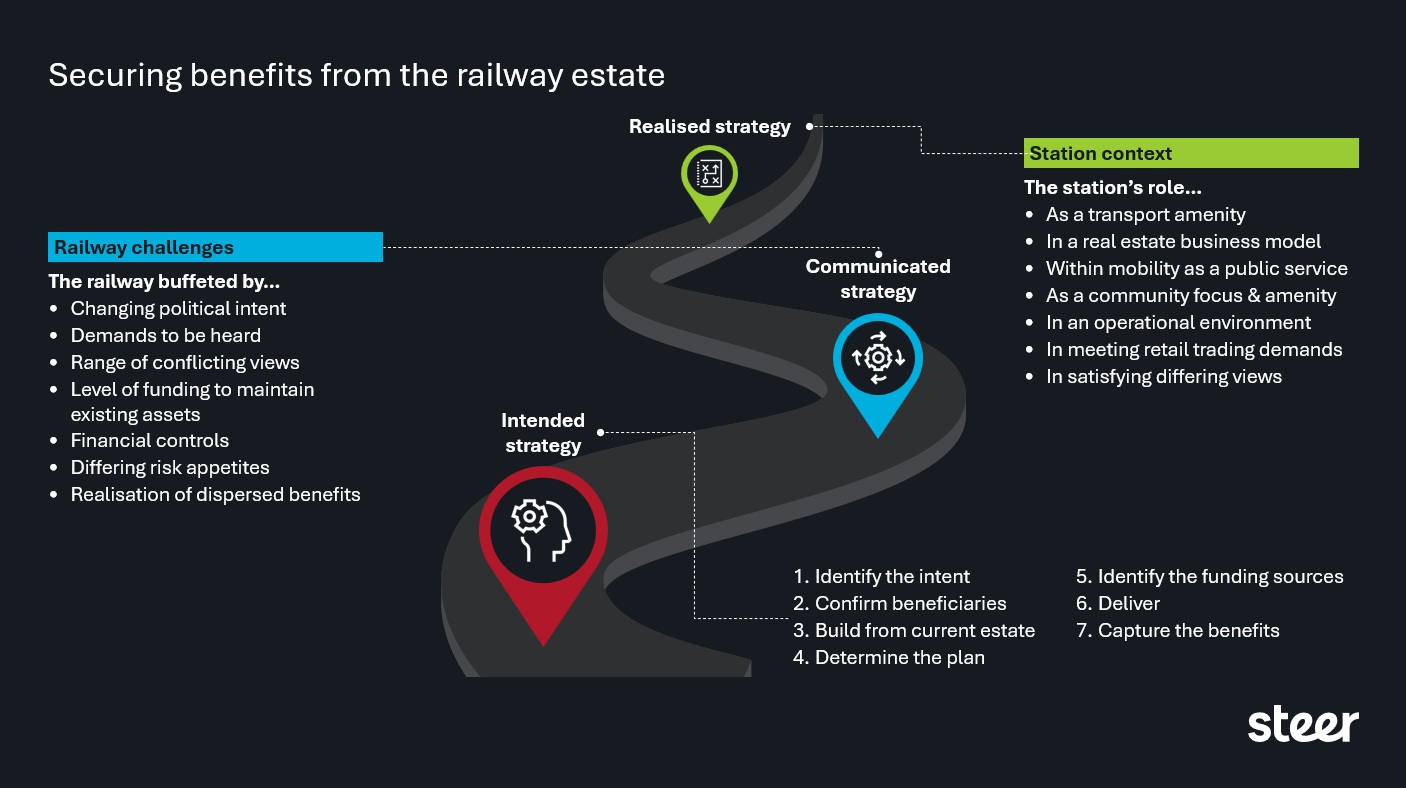
Moving forward with confidence
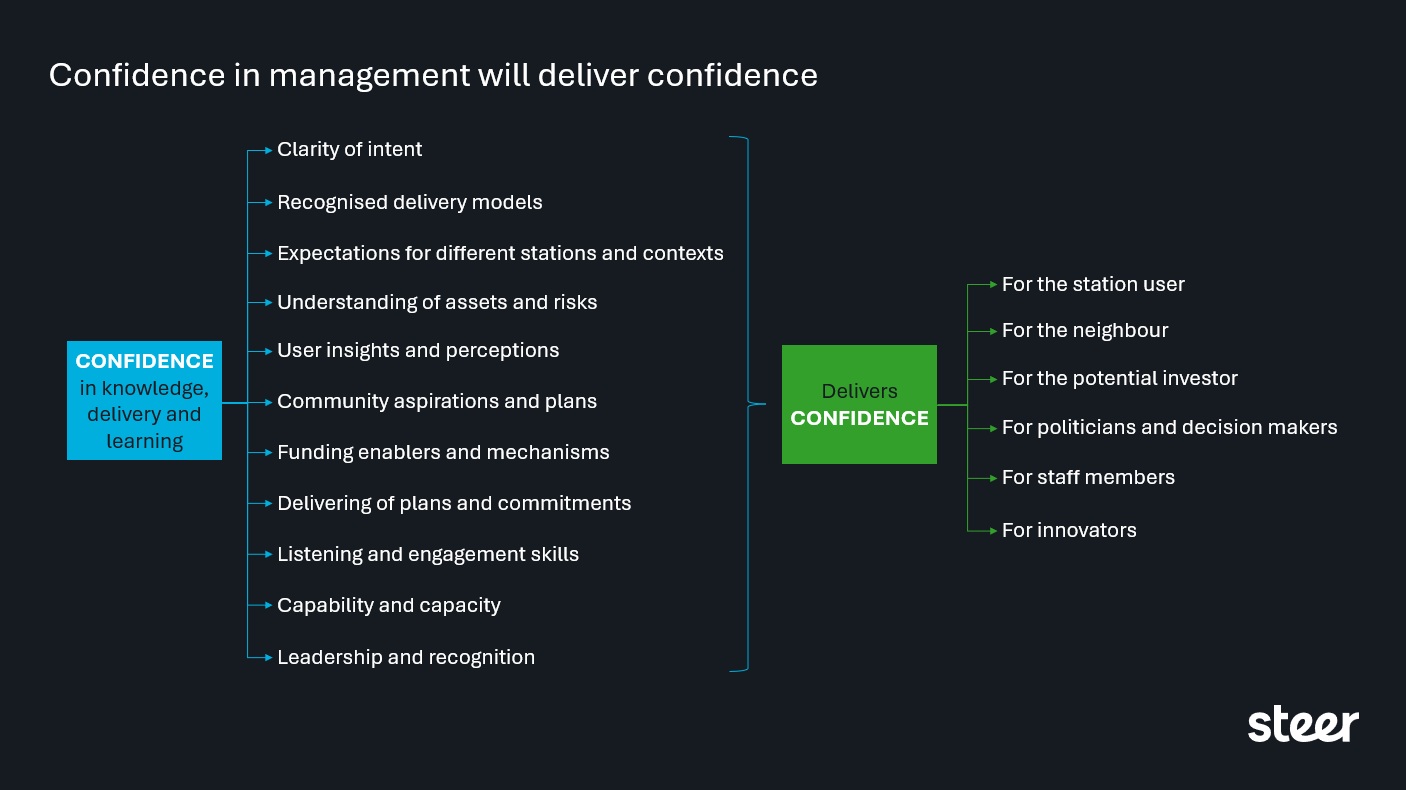
How can the industry then weather that turbulence and realise a strategy that maximises the potential of the estate? It needs to have and act with appropriate confidence.
- Confidence in understanding the communities which the railway serves and also in the current capabilities and condition of the estate.
- Confidence to openly engage and explore with stakeholders, partners and investors.
- Confidence in committing and delivering.
This confidence in knowledge, capability and delivery will be communicable. Open and authoritative engagement, and successful performance, will deliver confidence to station users, public and private investors, for our neighbours and workforce, and critical decision-makers who face tough expenditure choices.
That confidence in capability can be generated through an effective station strategy, which focuses on overcoming the challenges of estate management. A strategy that, as it is implemented deals with, and offers
- Improved data and insights about communities, current and potential users, and assets
- Availability of authoritative standard products and design approaches to drive economies of scale and speed of deployment
- Physical and temporal space for creativity and learning for new techniques, business models and product innovations
- Skills and management development, including technical, commercial, community and leadership aspects
- A comprehensive and ambitious view of what a performing estate should deliver for its communities, taxpayers, users and the railway
Such a strategy will lead to increased confidence and the ability to engage with the thorny issues of managing Britain’s estate. We need to equip ourselves now with the ability to constructively engage with partners in this unique and important feat.