Significant investment is required in infrastructure across North America to guarantee economic growth, sustainability objectives, and improved quality of life for everyday citizens, but at a time of tightening Government budgets, delivery is far from straightforward. Public-Private Partnerships (P3s) have emerged as a vital model for infrastructure development in North America, offering innovative ways to finance, build, operate, and maintain infrastructure.
In our series "P3 Evolution", we’ll explore how P3s are being used across sectors, including highways, rail, aviation, ports, and maritime, to create the transport landscape of tomorrow.

Public-private partnerships (P3s) have deep historical roots in Europe and North America, often emerging as pragmatic responses to infrastructure needs. While early forms were informal concessions, modern P3s with structured contracts and risk-sharing gained popularity in the late 20th century, especially in the UK and France, driven by fiscal pressures and a shift toward market-based delivery.
Now, after more than 30 years, P3s continue to gain traction in North America, evolving to rebalance the partnership and maximize benefits for all parties.
A P3 is a long-term contract in which a government and a private entity (often a consortium) share responsibilities and risks to deliver public infrastructure and services. The public sector typically sets policy and leads early concept planning, while the private sector often assumes design, build, finance, operations, and maintenance roles under one of two common payment structures:
- Revenue-risk concession: The private sector bears demand/revenue risk and is paid from user fees (such as toll revenues) within policy limits.
- Availability-payment: The public sector retains demand/revenue risk and pays the private partner to operate and maintain the infrastructure based on performance and asset availability, with deductions for under-performance.
Under either structure, if done well, P3s can accelerate delivery and unlock innovation. They can also allocate construction, lifecycle operation, and maintenance (O&M), and specific financial risks to the party best positioned to manage them, while preserving public-interest control over policy and service outcomes.
The following figure shows the number of U.S. surface transportation P3 transactions involving Private Activity Bonds (PABs) or Transportation Infrastructure Finance and Innovation Act (TIFIA) loans through the end of calendar year 2024. With the exception of the COVID-impacted years, the data reflects a consistent pace, typically between one and four transactions per year.
Figure 1: Number of and Average Value of P3 Projects in the U.S. by Year
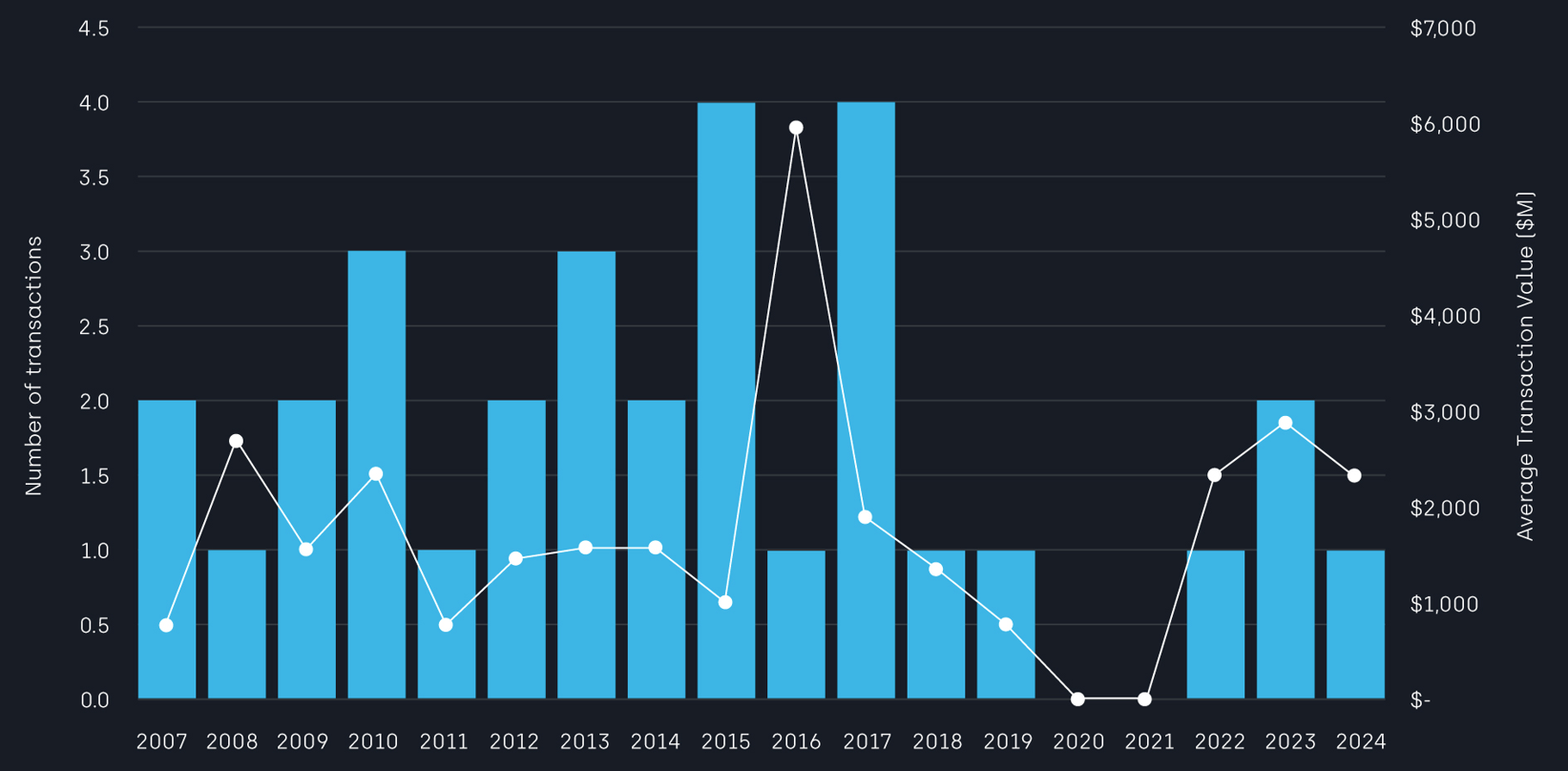
Source: Projects financed by TIFIA and Private Activity Bonds on the Federal Highway Administration’s website
P3 Evolution
With aging infrastructure and a competitive private sector market, the attractiveness of revenue risk transportation P3 concessions is growing, and along with this development, there has been an evolution in the balance of responsibilities and risks between partners:
- Early Approach: Traditionally, the public sector led the upfront planning, design, and regulatory groundwork. Once the framework was in place, the private partner was brought in to finance, deliver, and operate the asset, often assuming the full burden of revenue risk and corresponding revenue upside. This “transfer and operate” model positioned the private sector as a service provider expected to carry both financial exposure and operational accountability, with limited input into shaping the project’s structure.
- Evolving Practice: Over time, this approach proved too rigid, particularly in projects with high demand uncertainty or complex interfaces. Today, P3s increasingly recognize the value of engaging the private sector earlier in the process. Private partners are often selected not just as builders and operators, but as co-developers who contribute expertise during planning, demand forecasting, and structuring.
This shift distributes risk more thoughtfully: rather than placing all revenue and operational risk on the private sector, risks are now more shared. The public sector retains certain demand or policy-related risks, while the private partner helps optimize design, financing, and operations from the outset, increasing their anticipated revenue to improve project bankability and long-term performance.
Moving Forward
The modern P3 is no longer a one-way transaction, but rather a collaborative framework with thoughtful risk calibration, early collaboration, and a shared commitment to long-term performance. Some key points are now clear:
- One size does not fit all. The right model depends on demand certainty, policy goals, and delivery complexity.
- Co-develop the plan and co-own the outcomes. Engage operators early, align incentives to lifecycle performance, and share risks/opportunities.
- Structure for resilience. Build flexibility into the commercial framework to accommodate upside revenue sharing, evolving technologies, shifting policies, and potential volatility.
This evolution is unfolding right now across markets. Our Market Leaders are seeing it firsthand, and their insights offer a glimpse into how P3s will continue to adapt, innovate, and deliver value.