Transforming Britain’s rail sector – the legislative component
The UK Government's Railways Bill consultation outlines plans for GBR, improved efficiency, and a more integrated rail network.


Today the Government published its consultation document for a proposed rail sector reform bill (the “Railway Bill”), a step on the way to set piece legislation that could change our industry for a generation.
It is important to note that the consultation document largely focuses on the proposed bill and the legislative changes needed to bring about the Government’s policy for the railway. For the sector to successfully deliver it will require changes in culture and capability as well as processes and duties. Therefore, much change will be required and driven outside legislation, and here, the consultation just nods rather than provides detail. However, there are hints to characteristics of the organisations and their organisational design, e.g. “Local GBR Business Units” will benefit devolution the document asserts.
The Secretary of State’s consultation document sets out that the aim is to increase trust in Britain’s railway and simplify its current complexities, with six ‘objectives’ that the reforms are intended to bring about: reliability, affordability, efficiency, quality, accessibility and safety.
The Government also sets out some other intents with broad statements including “leveraging the best of public and private sectors” and “bringing cost and revenue together in a single organisation”. The consultation document is lighter on how these intents will be delivered and the path towards them from the current status quo.
You can see our one-page summary in the diagram below.
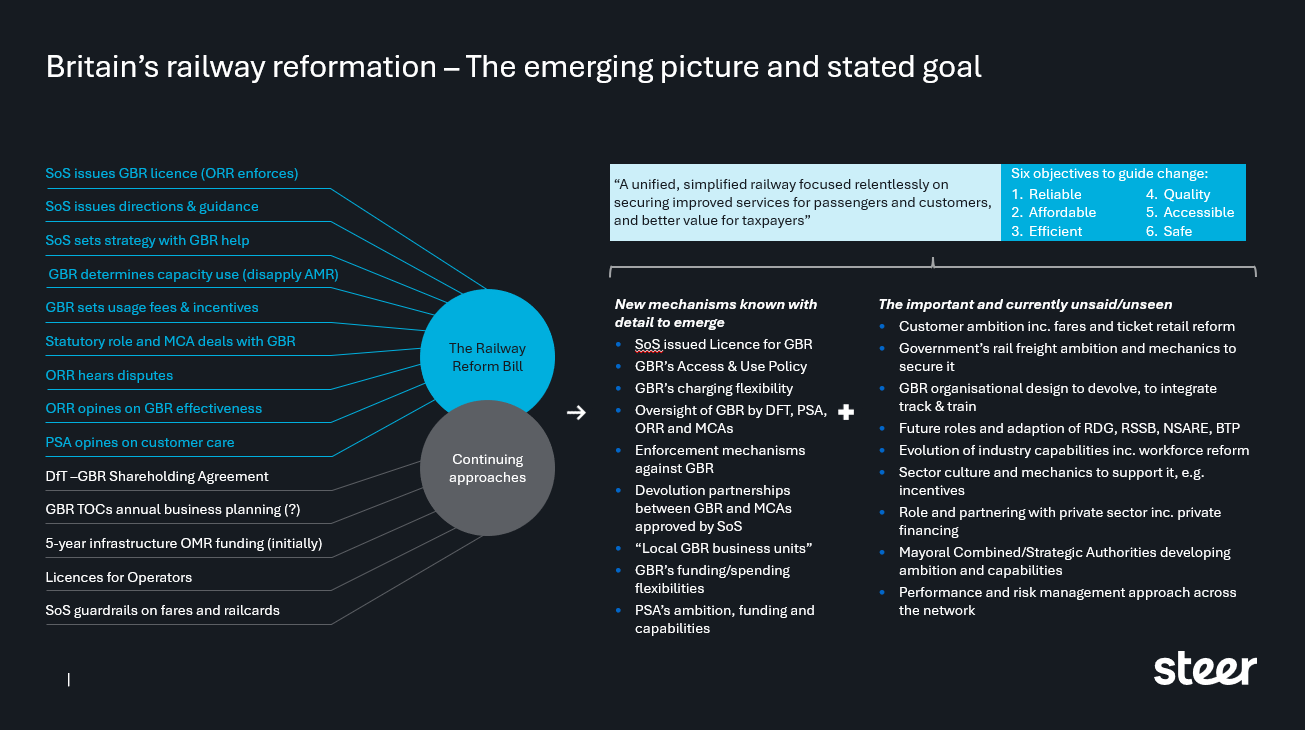
An area which is expected and clear is the establishment of the long-awaited Great British Railways (GBR), set to be a ‘directing mind’ for a refreshed industry with fewer interfaces, clear lines of accountability and joined-up decision-making. A significant shift in language over the last 12 months has been the degree to which GBR will be directed and empowered. Detailed design of the sector and GBR will determine if this clarity of accountability and commensurate ability to act will be realised.
A nod to this design is made with GBR intended to “unite track and train at a route level, with integrated management and joined up decision-making”. The challenge in establishing the new sector’s structure and behaviours is to deliver the “space for GBR to operate” whilst ensuring that taxpayer money is spent responsibly and third parties are treated fairly.
For those of us who have been engaged in the process since the Williams Review kicked off in 2018,, the consultation document holds few surprises;,. However, what draws the eye is not planned interventions but rather the things that have yet to be said or spelt out.
There is little reference to the sector’s culture, leadership or workforce skills, which may raise eyebrows given the high-profile issues of industrial relations and staffing shortages in recent years.
Likewise, despite statements about a continuing role for the private sector, there is not much to understand how, under a public ownership structure, this will be more than the residual roles and approach that currently exist. There are no brave statements about facilitating private investment or the creation of infrastructure or property concessions.
Open access, freight, ROSCOs and other third-party investors will naturally study the consultation document intently but are unlikely to come away completely reassured. The direction of travel is to give GBR greater accountability and power to determine capacity allocation and timetabling. The ORR’s role in regard to hearing disputes about access is more limited than currently. Similarly, the ORR will no longer be accountable for establishing charges for use of the network – a responsibility that will now be GBR within policy constraints set by the Government and a right of appeal to the ORR.
There is also no reference to the implications or expectations for the Rail Safety and Standards Board (RSSB) and the British Transport Police (BTP) or industry organisations like the National Skills Academy for Rail (NSAR).
The Railways Bill consultation represents a long-awaited milestone in rail reform. However, readers are likely to recognise that there is much still to be determined in how the Government seeks to implement its new model for the railway and, ultimately, how the leaders of the railway will then act. That means there is much for the sector to influence in terms of the details. However, the longer the debate goes on, the further away the benefits from a more cohesive approach to delivering will be.