Significant investment is required in infrastructure across North America to guarantee economic growth, sustainability objectives, and improved quality of life for everyday citizens, but at a time of tightening Government budgets, delivery is far from straightforward. Public-Private Partnerships (P3s) have emerged as a vital model for infrastructure development in North America, offering innovative ways to finance, build, operate, and maintain infrastructure.
In our series "P3 Evolution", we’ll explore how P3s are being used across sectors, including highways, rail, aviation, ports, and maritime, to create the transport landscape of tomorrow.

The development and operation of port assets is highly commercially attractive, making the nature of P3s in the ports and maritime sector different from their role in other infrastructure.
Major (often international) companies seize opportunities to generate successful and profitable holdings, including container terminals, bulk handling terminals, and auto roll-on roll-off facilities, negating the need for the subsidy commonly entailed in a P3 contract.
However, the development and ongoing operations of ports do require a robust relationship between the public and the private sectors. There are many interfaces where the public and private sectors meet in the operation of ports. Land use, access, and security are all examples where the public sector must take a role, while private terminal operators take responsibility for the handling of ship cargoes and ensuring terminal maintenance for proper functioning.
This relationship needs to be carefully managed to ensure that the objectives of the public authority are achieved and that any dependence that the private operator has on the public sector is satisfied without risk.
The relationship varies, but it is vital that the roles of both actors are clearly defined for success.
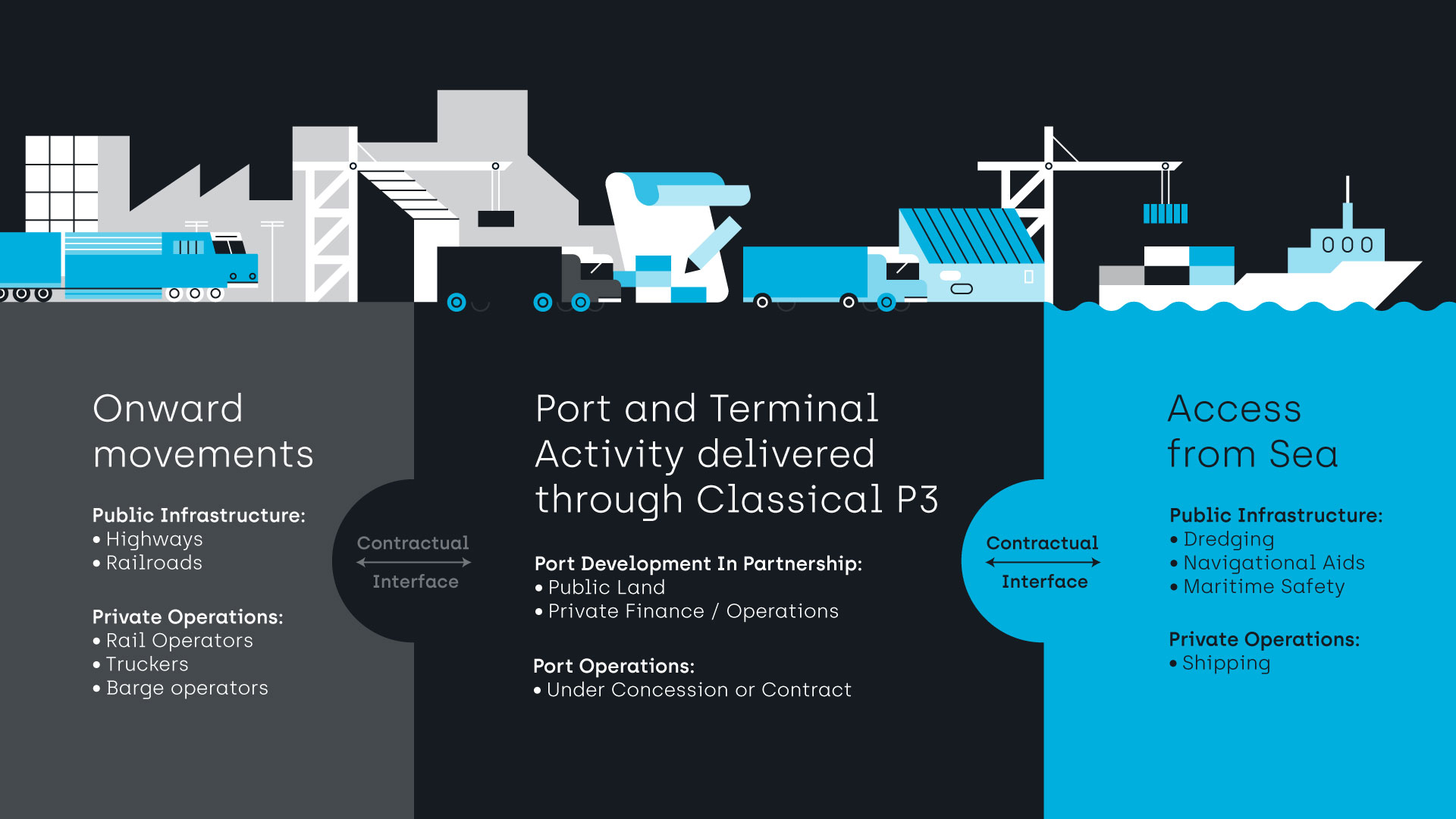
How public and private roles intersect across port access, terminal activity, and onward movements in port P3s.
Port P3s in developed economies
In North America, a region with a highly mature port sector, there are few opportunities for the development of new ports. However, there are significant opportunities for the construction of new terminals within existing ports.
These usually require a partnership between the public sector landowner (often the public port authority) and a private sector actor. In some cases, these projects are driven by local governments seeking economic growth and involve the private sector both in the development and delivery of new initiatives. They can take the shape of a design-build contract, a design-build and finance (DBF), or a design, build, finance, and operate (DBFO).
- Albany and Bayonne: The public landowner is keen to explore how their sites can be developed as a commercial opportunity. Both sites are under-utilised, and they are inviting potential developers to work with them, funding the planning process and ongoing development.
- Portland: The local authority is trying to attract new investors in an effort to maintain services after commercial withdrawals.
In other examples, the public sector is responding to positive commercial conditions by seeking to optimise development.
- Montreal: The project at Centrecoeur is ambitious – including the development of a terminal designed to handle more than 1 million twenty-foot equivalent units (TEU). Contracts have already been put in place for public procurement (in a design-build contract) of the underwater works. The developments above water, in contrast, are expected to be awarded on a fuller DBF or DBFO basis, with DP World in Canada (a joint venture between Caisse de Depot and DP World) indicated as the winners.
- Los Angeles: The Port Authority has recognised the need for extended capacity at the port and is looking for a private partner for the potential development of the Pier 500 marine container terminal. The pre-development agreement will have to explore the project delivery models, including financial strategy and risk allocation. Once developed, any new facility will likely be concessioned to one of the major international terminal operators.
There are a number of less complex projects where the public sector has clearly defined its objectives and is then working through a P3 / concession contract to develop the asset.
- Delaware: The port authority is working with the existing contracted company to operate the existing facilities and develop a new container terminal. It is anticipated that the operation of this new facility will be wound into their existing contract.
- Louisiana International Terminal: On the banks of the Mississippi just downriver of New Orleans, this will be a major new container facility built using a P3 procurement between the port authority, Ports of America and Terminal Investment Limited (TIL). The grantor will also be responsible for downriver works and road/rail access infrastructure, a project also likely to be procured through a P3 approach.
Public port authorities also have a role to play in an active secondary market, which sees sales and acquisitions target owners and long-term concessionaires. These assets are very attractive (either individually or bundled into national and international portfolios) with significant installed capacity, well-controlled costs, robust markets, and fairly inflexible competition. Public bodies often shield the private sector from unpredictable costs through their contracts.
The $20 bn transaction concerning the Hutchison portfolio (with more than 40 ports in around 25 countries) is a good example, but there have been a number of other smaller transactions across the Americas with Brazil, Chile, and Panama all drawing attention.
How can Steer help with P3?
The success of a port P3 relies on the establishment of clear and enforceable contracts. These contracts must set out the responsibilities of each party and reflect their respective aims, so the different parties act together for the overall success of the project.
These contracts need to establish the objectives and interests of each party, as well as the costs associated with the constraints placed on them.
For more than 30 years, Steer has stood at the centre of the development of P3 contracts in the ports sector and across transport. We have developed an understanding of the objectives and constraints of the public sector and the commercial ambitions of private developers and operators. This allows us to help to shape and deliver the frameworks under which P3s can play their essential role.
For further insights from our recent work on future port scenarios, explore our latest publication, Tides of Change. Read the full Tides of Change article.