
P3 Evolution: What opportunities are there for public-private partnerships in US airports?
Part of our P3 Evolution series, highlighting how aviation partnerships in North America are evolving beyond traditional models.


Significant investment is required in infrastructure across North America to guarantee economic growth, sustainability objectives, and improved quality of life for everyday citizens, but at a time of tightening Government budgets, delivery is far from straightforward. Public-Private Partnerships (P3s) have emerged as a vital model for infrastructure development in North America, offering innovative ways to finance, build, operate, and maintain infrastructure.
In our series "P3 Evolution", we’ll explore how P3s are being used across sectors, including highways, rail, aviation, ports, and maritime, to create the transport landscape of tomorrow.

The US is the world’s largest aviation market, boasting more airports than any other country, thanks to its massive population, large landmass, affluent residents, and globalized economy.
US airports, traditionally owned and operated by various forms of local and state government, are typically well run but at times face challenges of public bureaucracy and administration, which have resulted at times in sub-quality passenger facilities, congested infrastructure, and underwhelming customer services.
Moves to privatize airports, for example, through the Airport Investment Partnership Program (AIPP), have been relatively unsuccessful, with access to cheap, tax-advantaged bond financing, continued Federal Aviation Authority (FAA) heavy-handed economic regulation, and owners' reluctance to give up assets all having dampened efforts.
Global airport operators, experienced in managing development, financing, and operating airport assets in some of the world’s largest aviation markets, have long looked at the United States as a major untapped proposition.
These companies see themselves as capable of helping public US authorities to develop and improve infrastructure, while earning reasonable returns on their investments, achieved through a combination of operational cost savings and increased commercial returns of the assets.
Steer continues to see significant participation and interest among private developers and operators in US airports, not within the AIPP but with individual assets and tailored procurements at airports.
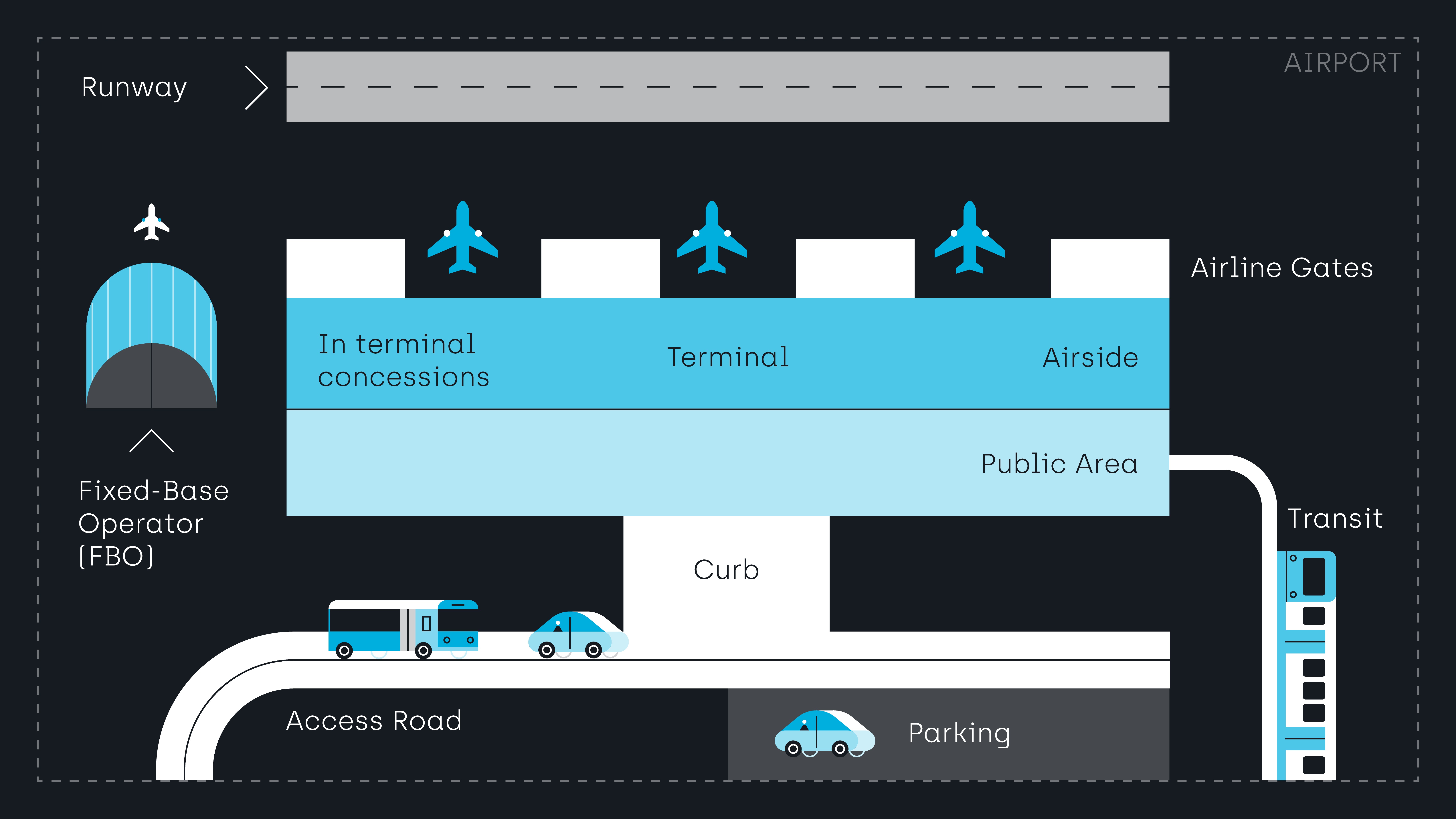
Overview of P3 opportunity areas within an airport. Source: Steer.
P3s in New York and New Jersey Airports
The Port Authority of New York and New Jersey demonstrates a willingness and interest in engaging private developers to design, build, operate, finance, and maintain large terminal facilities. Outside of the legal and policy framework of the AIPP, New York has concessioned individual terminal complexes, including JFK T4 (led by Schiphol), LGA TB (led by Vantage) and for the 2 new terminals under construction at JFK – New Terminal One (where Steer has supported the consortium of Ferrovial, JLC, Ullico and Carlyle) and Terminal 6 (also led by Vantage).
These projects have provided opportunities for developers and airport management firms to invest billions of dollars of capital while bringing in professional airport managers, construction teams, and advisors from around the world. LGA, previously the subject of jokes for its poor passenger services, has been transformed into an award-winning airport. JFK, in turn, is on track for a similar experience, elevating passenger experience and improving airline operations, while freeing up capital and providing more resources for the PANYNJ to invest in other projects and priorities.
EWR has a new Terminal A, which was not developed as a full P3 but rather with a management contract (operated by Munich Airport). Alongside it, Terminal B is badly in need of replacement, and PANYNJ is currently evaluating how best to deliver that project. Should it be procured as a full P3 like LGA TB or the new JFK terminals, there will be significant interest from large-scale airport operators and developers.
However, thanks to its market demand and unique governance model, New York has proven to be the exception. Elsewhere, large terminal projects have not materialized except for airline-led development projects.
P3’s in Terminal Concessions
Airports have long relied on traditional retail and food and beverage operators to offer passengers in-terminal concessions. In many cases, airports rely on prime concessionaires to operate and manage several units, then fill out that portfolio by selecting specific offers, sub-operators, and brands. Over the past 20 years, we have seen the rise of an expanded investment opportunity in the form of the “developer” model, whereby a single private entity is responsible for investing in the design and development of the entire concessions program, including long-term management of the sub-concessionaires. This model has been popularized by firms including Fraport and URW, with the latter’s US airport portfolio recently acquired by Asur. Other examples include the development and operation of Kansas City’s concessions program by Vantage when the new passenger terminal opened in 2023.
Ground Access
Airport ground access is becoming one of the most significant operational challenges for US airports. Airports have benefited from industry-wide upgauging over the past 30 years, allowing for significant increases in passengers without major increases in airfield usage. In addition, US airports generally benefit from relatively generous federal funding for airfield-related projects, which has allowed the industry to handle significant passenger growth without major airfield challenges (air space management is a different story, where we are starting to see significant signs of strain).
With more passengers arriving and departing on each flight, roadways and transit connectors are becoming increasingly congested, often tilting airport curb fronts and parking facilities to the breaking point. We have seen investment in on- and off-airport parking facilities (for instance, KKR acquired The Parking Spot in 2024) and in people mover systems, like the soon-to-open LAX people mover (delivered as a P3). Rental Car centers have been another area of growth, with Conrac Solutions, among others, leading the way in developing specialized facilities as P3s, allowing airports to focus resources on more “core” assets such as terminals and airfields.
Special Passenger Services
The travel market has shifted to embracing “premium” travel – a trend which has accelerated since COVID. While privately owned and operated Fixed Based Operators (FBOs) and exclusive airline lounges have long been a part of the airport landscape, the market continues to evolve, providing more opportunities for private investment. PS, a company owned by French airport operator ADP, has opened private terminals at LAX, Atlanta, and Paris (CDG).
Customers using a private on-airport terminal can choose from a variety of services, including security, a holdroom, and even being chauffeured to the aircraft for boarding. In the lounge space, the rise of third-party lounges – led by credit card companies – has created expanded opportunities for private operators like Plaza Premium and TAV (although business plans are often made on providing a credit card amenity and not on the profitability of the lounge itself).
Looking Ahead
Outside of these niches, there remains significant interest from the private sector in broader airport development opportunities.
One area where new opportunities may present themselves is in smaller airports, many of which have aging facilities in need of investment, lack staff capacity, and the financial resources to be able to undertake transformative replacement and enhancement projects.
We have seen some success from firms like Avports targeting smaller airports to develop facilities and attract new commercial airline services to markets like New Haven and Manassas. With the lack of progress on updating PFC limits and aging infrastructure, it’s possible there may be additional smaller markets, such as Snohomish (Washington), that use private equity capital (Propeller Investments) to build new infrastructure or address existing and aging facilities.
The common thread among these opportunities is that private sector involvement has the flexibility, specialization, and scale to manage transformative capital programs and new service offers and can use this to complement public management.
Opportunities exist and creative investors and operators are finding ways to deploy capital and expertise for the improvement of US airports. As the P3 model continues to evolve in the U.S., the need for independent, data-driven analysis has never been greater. Identifying which types of projects truly benefit from private investment and structuring to align with public and private incentives is a complex enterprise.
At Steer, our experience advising investors and public authorities across these different types of transactions keeps us engaged and looking to help create sustainable business models that improve airports and better serve communities.
Let’s continue the conversation
With extensive experience in transaction advisory across highways, rail, aviation, and ports and maritime, Steer supports partners navigating evolving P3 models.
Other Articles in This Series




P3 Evolution: How to build the next generation of US highways

Our P3 Evolution series examines how highway partnerships in North America are advancing through smarter risk sharing and innovation.
Read more

P3 Evolution: How are public-private partnerships shaping a new generation of North American infrastructure?
Our P3 Evolution series explores how public-private partnerships are shaping the future of North American infrastructure.
Read more