How can data centres help heat decarbonisation?
Data centres generate heat 24/7; could this untapped resource be the key to low-carbon, resilient urban heating?


This article was originally part of our Game Changers report on megatrends in the future of infrastructure. Read the full report here.
The last five years have seen space heating thrust into the public discourse in a way we have not seen since the energy crisis of the 1970s.
Bill increases for consumers across Europe in the wake of the COVID-19 pandemic, the war in Ukraine and more recent developments in the Middle East have created a politically charged atmosphere for bill payers and legislators alike. In this environment the race to decarbonise heat is cast in a new light.
To meet its legally binding net zero target by 2050, the UK must fundamentally change how heat is supplied to homes and businesses. Heat networks currently meet just 2–3% of demand but must scale to close to 20% by mid-century, making large, reliable low-carbon heat sources essential.
Low carbon heat networks are a key tool to decarbonising heat for homes and businesses, by using heat offtakes from sources such as sewage works, water treatment plants and underground transport systems to heat multiple homes at a time.
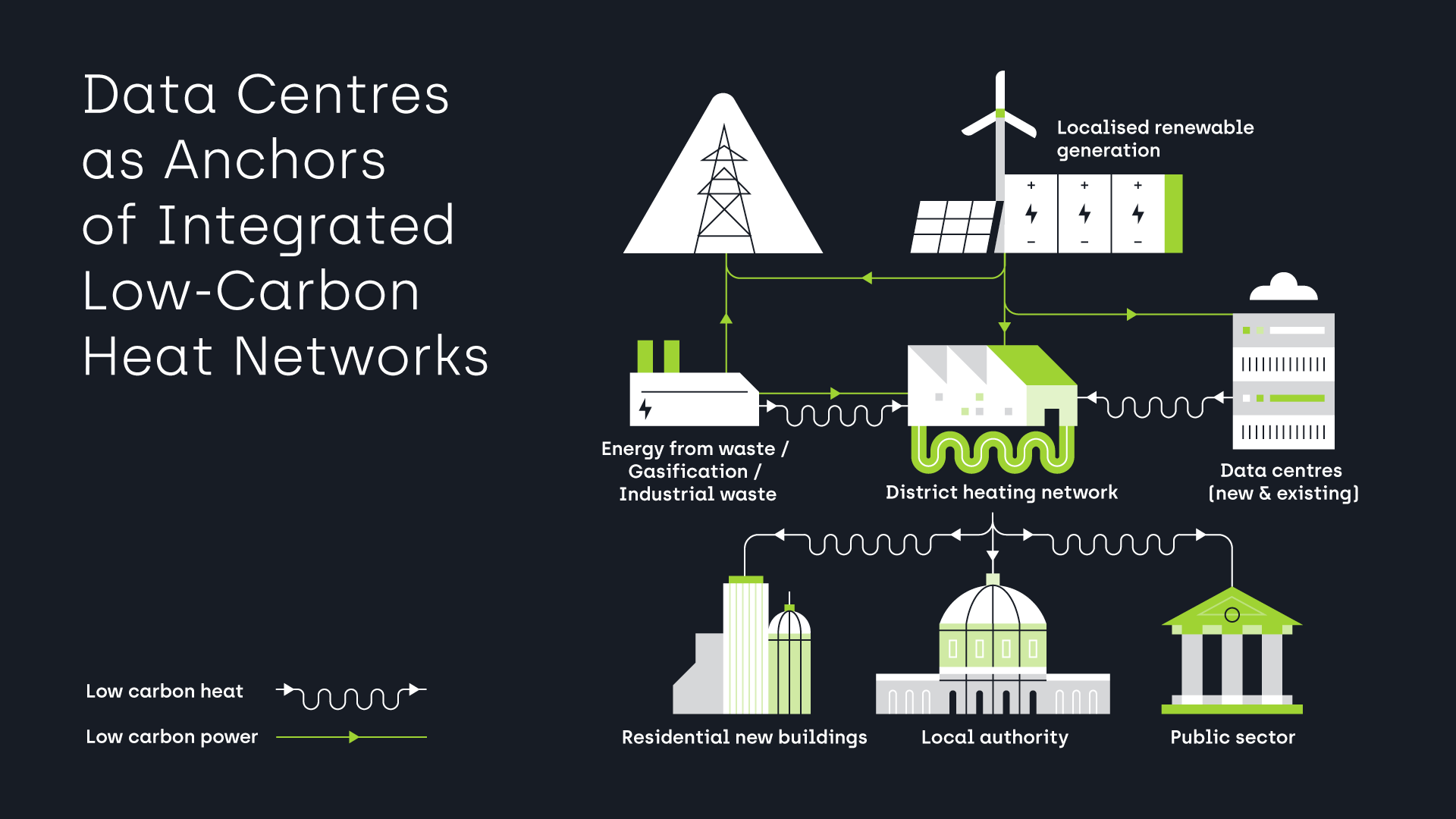
Heat networks are uniquely suited to integrating heat from sources that would otherwise be wasted, converting a local by-product into a shared system-level asset. Unlike individual building solutions, they allow heat supply to be decoupled from heat demand, creating flexibility to combine multiple low-carbon sources over time and reduce reliance on fossil fuels as networks expand.
Digital infrastructure is attracting high levels of investment and data centres offer an exemplary source of waste heat. Already some key players in the industry are exploring how to export heat to local communities with operational examples found in Helsinki, Oslo and Dublin.
Data centres are particularly well suited to this role. They produce large volumes of consistent, year-round heat, often in or close to urban locations, in proximity to existing and future heat demand. As cooling technologies evolve and server densities increase, the quantity and stability of recoverable heat is becoming more predictable, strengthening the case for long-term integration with heat networks.
Legislatively, Data centres are now designated as critical infrastructure in the UK, Germany, Ireland, France and the Netherlands. In 2023 Germany enacted the stringent Energy Efficiency Act (EnEfG) which mandates new facilities to utilise 10% of waste heat if operational from 2026 and 15% from 2027. More recently, in France a law was passed in 2025 that transposed the EU Energy Efficiency Directive which requires data centres over 1 MW to install systems to recover waste heat.
These regulatory developments mark a clear shift: waste heat recovery is moving from voluntary best practice to an expected component of responsible data centre development. While the UK has not yet adopted equivalent mandates, the direction of travel is clear, and future planning and permitting regimes are likely to place increasing emphasis on demonstrable heat reuse where viable demand exists.
Data centre construction is currently in a sweet spot which sees ravenous appetite for provision outstripping delivery. However, this will curtail over the next decade as hyperscalers’ projects come on stream.
This moment of intense build-out represents a narrow but critical window. Decisions taken today on-site selection, layout, cooling strategy and grid connection will lock in outcomes for decades. Retrofitting heat recovery after construction is materially more complex and expensive than designing for it from the outset, reinforcing the importance of early engagement between developers, planners and heat network promoters.
As the data centre boom unfolds however, considering waste heat recovery at the earliest opportunity is essential. Lessons can be learned from the waste sector in the UK where a hierarchy of usage combined with a decade-long, predictable, increasing tax rate on disposal of waste, managed to limit the amount of waste sent to landfill. A similar approach with the right key stakeholders could change the game on waste heat.
A comparable hierarchy for heat - prioritising reuse over rejection - supported by clear policy signals and long-term certainty could unlock investment at scale. This would rely less on blanket mandates and more on targeted incentives aligned with genuine local heat demand and robust heat planning.
Co-location provides a practical route to delivery. Data centres sited alongside district heating energy centres or renewable assets can share plant, land, grid connections and planning costs, while improving resilience and easing grid constraints. For heat network developers this reduces fuel risk; for data centre operators it delivers operational savings alongside a credible ESG benefit.
Modular, phased design is equally critical. Data centres are built in large capacity blocks, while heat networks grow incrementally; modular heat recovery allows capacity to scale with demand, avoiding over-investment and improving bankability.
Challenges remain, including low-grade heat, alignment of build-out timelines and rapid technological change. Above all, heat recovery must not compromise IT customer requirements on availability, resilience or total cost of ownership, and must be demonstrably neutral - or beneficial - to data centre operations.
At a time when there is a backlash to the green agenda, heat recovery could be a huge PR win for both the industry and Government. But strategic planning and careful selection of carrots and sticks is needed to link projects to proper utilisation and make them a success.