Building a safer road environment: practical measures to support the UK’s new Road Safety Strategy
A practical perspective on how street design, infrastructure, and enforcement can help turn the Government’s new Road Safety Strategy into safer outcomes on the ground.

The UK Government has launched its new Road Safety Strategy, setting out a renewed national commitment to reducing deaths and serious injuries on our roads. The strategy reinforces the importance of safer vehicles, safer behaviours, and improved enforcement, and provides a welcome platform for continued action across the transport system.
Steer welcomes this announcement and sets out six further considerations for practical interventions that could consistently support safer outcomes on UK roads. Drawing on our work with local authorities and transport bodies across the UK, as well as insights shared through our London Borough Knowledge Exchange events, we believe these interventions can help translate the Government’s national ambition into real-life results.
1. Speed management, reinforced by street design
Vehicle speed plays a significant role in both the likelihood and severity of collisions, particularly in urban environments with high levels of pedestrian and cycle activity. Clear and consistent approaches to speed management can help improve safety outcomes, especially for more vulnerable road users.
Importantly, speed limits are most effective when reinforced by street design, as the physical characteristics of a street strongly influence driver behavior, regardless of the posted limit.
What this looks like in practice:
- Wider use of 20mph speed limits in urban areas has shown great results in reducing road casualties without impacting journey times in Wales
- Raised junctions and crossings on residential and high-footfall streets
- Narrower carriageways and tighter corner radii to reduce vehicle speeds
- Visual cues such as planting, materials, and continuous footways
- Designing streets that naturally encourage slower speeds reduces reliance on enforcement and creates calmer, more predictable environments
2. Making safe walking and cycling infrastructure the default
The Strategy recognises the vulnerability of people walking and cycling. The next step is to ensure consistency of design: high-quality walking and cycling infrastructure shouldn’t be the preserve of ‘active travel schemes’ but should be standard practice as part of good street design.
What this looks like in practice:
- A strategic approach to local traffic management to ensure most streets in urban areas are suitable for safe cycling without the need for ‘protected’ infrastructure to ensure the majority
- Side roads junctions which reinforce pedestrian priority – hopefully through side road zebra crossings if the government legislates for them in the future
- Walking infrastructure accessible to all, with dropped kerbs on desire lines, correct tactile paving, and controlled crossings where needed
- Protected junction designs to reduce conflict between vehicles and cyclists, such as this example shown on Google Maps
When infrastructure is predictable and well understood, it reduces uncertainty, improves compliance, and significantly lowers risk for all users.
3. Scaling up School Streets and child-focused street design
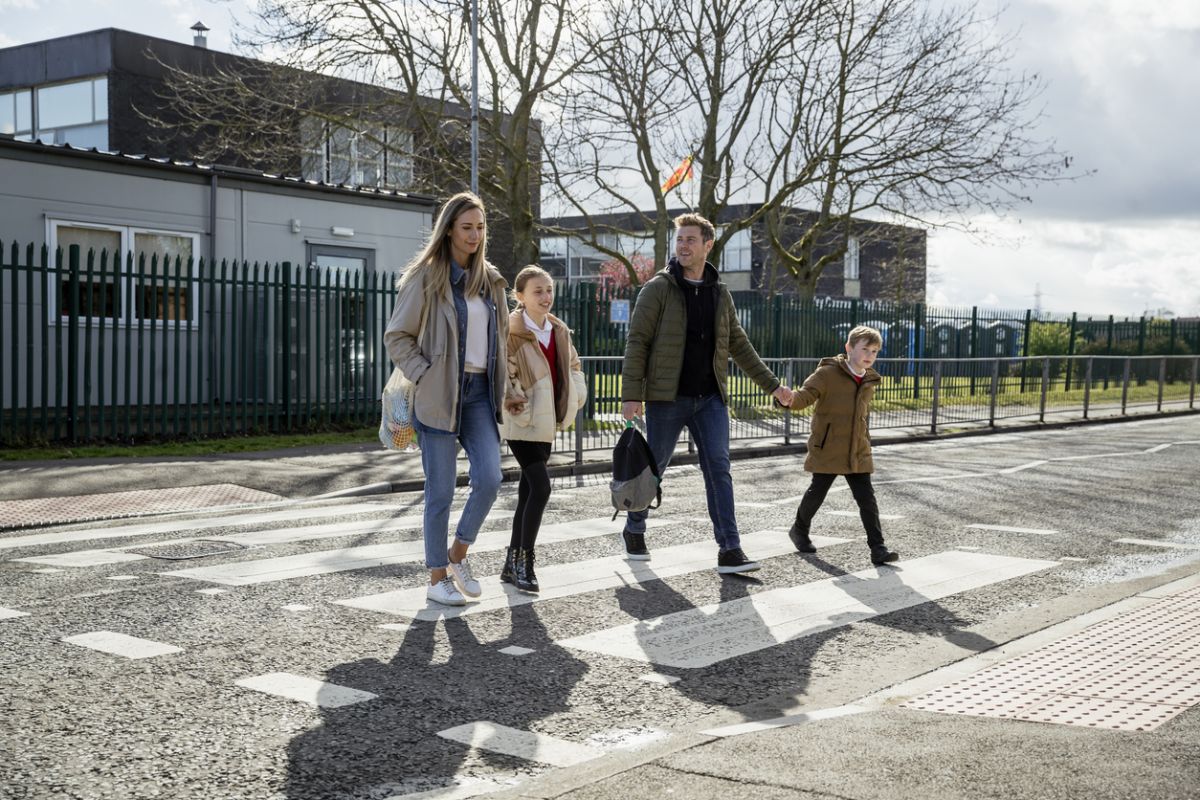
School Streets are one of the most effective and publicly supported safety interventions in recent years. They reduce traffic danger at peak times, improve air quality, and encourage walking and cycling.
Yet they are still often treated as pilots rather than core safety measures.
What this looks like in practice:
- Timed vehicle restrictions outside schools, supported by clear signage and simple enforcement
- Raised tables, widened pavements, and safer crossings at school entrances
- Safer walking and cycling routes to school, not just safer streets directly outside the gates
Designing streets around children’s needs creates safer environments for everyone and embeds healthier travel habits from an early age.
Steer has provided consultancy support to a number of local authorities on how best to design and implement School Streets, including Camden and Hackney.
4. A stronger focus on high-risk junctions
A disproportionate number of serious collisions occur at junctions, yet many safety programmes focus primarily on corridors or lengths of road. Targeting junction design can deliver significant safety benefits with relatively modest interventions.
What this looks like in practice:
- Removing slip lanes and high-speed turns in urban areas
- Tightening corner radii to slow turning vehicles
- Protected cycling facilities as standard at busy junctions.
Small geometric changes at junctions can dramatically reduce collision risk and severity.
5. Keeping pavements clear through action on pavement parking
Pavement parking continues to present a significant barrier to safe and accessible movement, particularly for people who rely on clear footways. Five years on from the Government’s consultation, emerging new local powers will provide an opportunity for more consistent and locally appropriate approaches to keeping pavements clear, without relying solely on street-by-street restrictions.
What this looks like in practice:
- Area-wide approaches to managing pavement parking, rather than isolated exemptions
- Clear design cues and physical measures that discourage pavement parking where footway width is limited
- Proportionate enforcement focused on locations where obstruction creates safety or accessibility risks
- Integrating pavement parking considerations into street design, maintenance, and public realm schemes
Clear pavements reduce the need for pedestrians to step into live traffic, improving safety, accessibility, and confidence for all users.
6. Addressing ‘fake’ e-bikes to improve pedestrian safety and confidence
The growth in illegally modified or non-compliant e-bikes has become both a real and perceived road safety concern, particularly from a pedestrian perspective. Vehicles capable of higher speeds, or being used in inappropriate spaces such as footways, can create conflict, reduce confidence, and undermine the wider benefits of micromobility.
What this looks like in practice:
- Reinstating ‘worker’ status for gig economy riders to guarantee rights and protections, as recommended in the Unregulated and Unsafe: The Threat of Illegal E-Bikes report
- Introducing a legal requirement for delivery platforms to run real-time compliance checks on bikes used by couriers
- New and simpler powers for police to seize unsafe e-bikes, as set out in the Unregulated and Unsafe: The Threat of Illegal E-Bikes report
- Clear public communication on what constitutes a legal e-bike and where it can be used
- Street design that clearly distinguishes pedestrian space from cycle and vehicle movement
Tackling fake e-bikes protects other road users and helps maintain trust in active and sustainable transport modes.

Turning strategy into safer streets
If you’re looking to translate the Government’s new Road Safety Strategy into practical, deliverable interventions on your network, our team works with local authorities to prioritise, design, and implement measures that reduce risk where it matters most.