Climate Change Briefing
Climate Change Committee says UK needs a step change to meet carbon budgets.
Climate Change Committee says UK needs a step change to meet carbon budgets.
Background
In its first annual report to Parliament (published 12th October 2009) , the Committee on Climate Change concludes a step change in the pace of carbon dioxide (CO2) emissions reduction is needed if legal carbon budgets set in last year’s Climate Change Act are to be met. In some areas, new policy approaches will be required to deliver the Government’s Low Carbon Transition Plan. The report focuses on progress in the years running up to the first budget period, and identifying the indicators that the CCC will use track the level of CO2 emissions versus budget. Key findings of the report are:
- Between 2003-2007 CO2 emissions fell on average by 0.5% per year. However in the future, a reduction of 2-3% each and every year will be required if the carbon budgets are to be met.
- This means a step change in the pace of reduction is needed, and Government policies and activities will need to change to reflect this.
- The UK should now aim to overachieve emissions reductions in the first budget period.
Action in Different Policy Areas
The CCC report states that there is a need to revise or strengthen policy in 3 main policy areas:
- Electricity generation: Here, rapid decarbonisation is a crucial priority, and 23 GW of new wind capacity, up to 3 new nuclear stations and up to 4 CCS demonstration plants by 2016 are all likely to be needed. The CCC also calls for a review of arrangements to reduce investor risks and ensure delivery of investment in low-carbon technologies.
- Energy efficiency in homes: This could be improved by 35% by 2020. However, this will need an ambitious program of improved insulation (e.g. covering 10 million lofts, 7 million cavity walls and 2 million solid walls), the installation of 12 million energy efficient condensing boilers, and major improvements in electrical appliance efficiency. This is likely to need a shift from the existing Carbon Emissions Reduction Target (CERT) approach to a “street-by-street” approach involving local government and energy companies within a strategy defined by national Government.
- Road transport: CO2 emissions from transport need to be reduced through a combination of efficiency improvements and measures to manage demand. By these means, the CCC is looking for cuts of 30% by 2020.
Looking at transport in more detail
The CCC is looking for a reduction of 24 MtCO2 in emissions from surface transport by 2020. While technology will provide some of the answers to meeting this challenge, the majority of the reduction is expected to come from changes in travel behaviour. Some 13 MtCO2 (54% of the total) is expected to be saved by:
- Wide application of “Smarter Choices” principles, based on the lessons learnt from the Sustainable Travel Town pilots could save 3 MtCO2;
- Training some 4 million drivers in “eco-driving” techniques, and getting them to put these into practice could save 1 MtCO2;
- Effectively enforcing the 70mph speed limit could save1.4 MtCO2;
- Integrated transport and land use planning to reduce the need to travel could save 2 MtCO2; and
- Road pricing could save additional 6MtCO2.
By comparison, technological improvements to the car fleet, principally meeting the EU targets for new car emissions of 130g/km in 2015 and 95g/kmin 2020, could save 11MtCO2. However, the UK’s track record in this has not been good, and the trajectory for meeting these targets still lags behind that necessary to meet the targets, as illustrated below:
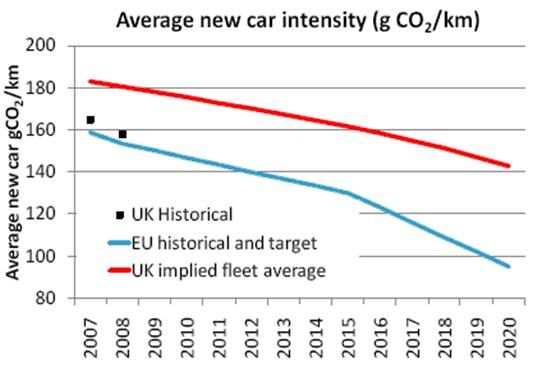
Source: Climate Change Committee
Implications for transport policy
To ensure rapid progress in meeting the reduction targets for transport technology, the CCC suggests that two new mutually reinforcing government policies are required, i.e.:
- Support for new car purchase to drive initial volumes and help manufacturers achieve economies of scale; and
- Support for battery charging infrastructure.
However, if transport is to deliver on its planned reductions in carbon emissions overall, a radical change will be required in how transport planning responds to the challenge. For the upcoming third round of local transport plans, carbon reduction will be a critical issue, and local transport authorities will need to develop strategies and measures that:
- Identify what “Smarter Choices” measures are appropriate and will be effective in their own areas, and develop strategies of fast and effective implementation, as well as developing measures to lock in the benefits over time, so that CO2 savings can be realised
- Deliver driver training in “eco-driving” in programmes similar to the present “Bikeability” programme, and public information programmes to ensure drivers put the techniques into practice
- Measures for more effective enforcement of speed limits, using both surveillance and traffic management techniques.
- Proper evidence that land use planning policies are designed to reduce the need to travel, by promoting co-location of activities and avoiding decentralisation of key facilities.
- Much more effective provision for improved public transport services, and practical measures to promote use of these, both through infrastructure provision and through partnerships with service operators.
- Before being dismissed as inappropriate, a proper consideration of the role that road pricing can play in the more efficient use of the existing road network in all areas (urban and rural), developing targeted measures that overcome the public’s distrust of such schemes.