Article

Need for Speed in Mexico?

Mexico is a formidable contender on the global stage of advanced emerging markets.

By Steer

With the second largest economy in Latin America by nominal GDP (14th in the world), Mexico is a formidable contender on the global stage of advanced emerging markets. As it moves forward in this arena, the politicians of the day steer the debate towards increased public and private investment in infrastructure, with an estimated 1.3 trillion pesos (USD 90 billion) earmarked for transport and communications over the next five years. 

While the aspirations of smarter and innovative technological solutions are ever-present, the immediate future must cater to a more basic and increasingly urgent need: efficient and reliable mass public transport. Mexicans, like other north Americans, see cars as a status symbol but the usual crises of congestion, costs and carbon footprint are driving the discussion towards rail and more ambitiously, the high speed version. This is a topic currently being discussed across the globe, from the USA’s high speed rail plan all the way to India’s vision of a ‘diamond quadrilateral’ proposed to join the major cities – the world is dreaming of bullet trains.

Whether the question is one of providing a new alternative to the age old road (as in the USA) or a solution to congestion and capacity constraints on existing rail networks (as in Europe and India), the potential benefits of conventional rail are well understood. Nonetheless, when one examines the case for high speed with a critical eye for determining whether it is truly warranted, the following factors play a key role:

  • Geography: interurban rail works best for city centres 200-600 kilometres apart with a high demand for connectivity. Mexico, like high speed countries France, Spain, Italy and Germany, has a capital and a major second city within this range.
  • Stable demand: year-round business demand is better than seasonal or leisure traffic, all-day demand is better than once-a-day commuter peaks.
  • Land use and topography: lines are easiest to build in near-empty countryside with gentle gradients minimising the need for tunnels and viaducts. Even so, in Europe both the Pyrenees and the Alps will soon be crossed by high speed lines.
  • Access to, and space for, terminals: ideally a clear corridor to a central location, ideally both near to business demand and well-connected by local transport.
  • Passengers familiar with rail as a mode: rail is already familiar, high speed rail will take them further and faster.

Mexico meets the first two criteria but its topography, urban layout and familiarity with rail are less favourable; most intercity passenger rail services were abandoned in the late 1990s and few cities have urban transit systems. As elsewhere in North America, there may be a need first to build urban rail networks, and a rail-familiar passenger base, before high speed rail can become the mode of choice for interurban travel.

Steer Davies Gleave has been providing advice to the global rail market since 1979 and is the rail sector’s leading independent consultancy. We have been active in the Latin American markets since the mid-1990s and have recently supported the Brazilian Government in its implementation of a new open access model for its railway network. 
Off

Subscribe to our newsletter, The Edit

We are Steer

Yes, you are in the right place. After 40 years, we have changed our name from Steer Davies Gleave to mark our growing international footprint and our expanding portfolio into sectors beyond transport.

Explore our new website to learn more about Steer: who we are, how we work and what our future holds.

Related insights

  • 05 Dec 2025
    Article

    Bus ridership 2024-25: How do different combined authorities fare across the UK?

    By Steer

    Bus ridership shifts revealed; discover where recovery is rising, stalling or slipping across the UK.

    Read more

  • 04 Dec 2025
    Article

    Steer’s production of new rail demand data for ORR shows renewed momentum across Great Britain

    Mark Brownie
    Associate

    Explore how Britain’s rail demand is stabilising, with fresh ORR data revealing renewed growth and shifting journey patterns.

    Read more

  • 27 Nov 2025
    Article

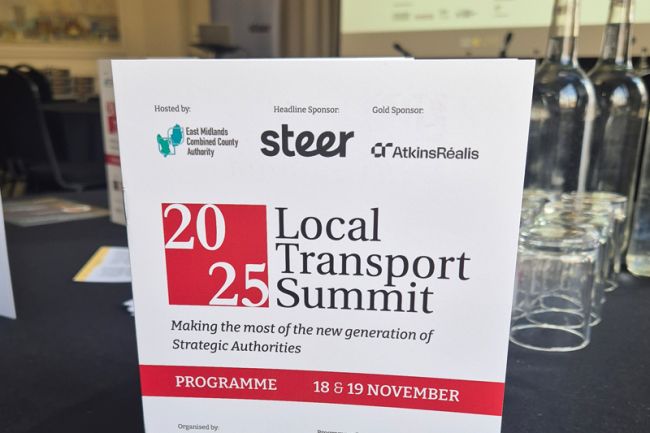
    What did we learn at the Local Transport Summit 2025?

    Simon Statham
    Director
    Nicola Kane
    Director

    Human-centred decision-making is shaping the future of local transport – here’s what we learned at the 2025 Summit.

    Read more

  • taxis
    24 Nov 2025
    Article

    Dynamic pricing: How can European cities adapt to this innovation in taxi fare setting?

    Susmita Das
    Susmita Das
    Associate

    How flexible fare models enhance performance and transparency for a more sustainable taxi system.

    Read more

  • 14 Nov 2025
    Article

    Britain’s rail stations: The ring of confidence

    Profile image
    Mike Goggin
    Managing Director, Transformation & Growth

    Exploring how greater industry confidence can shape stronger, more successful stations for 2035.

    Read more

  • 05 Nov 2025
    Article

    The Railway Bill: Building a new railway sector for Britain

    Profile image
    Mike Goggin
    Managing Director, Transformation & Growth

    The Railways Bill outlines the framework for reform – but its impact will depend on delivery and leadership.

    Read more

  • 22 Oct 2025
    Article

    Game Changers: The megatrends that will redefine global infrastructure

    Jon Peters
    Associate Director

    Our latest global insight report exploring the forces transforming how we move, power, and connect the world.

    Read more

  • 24 Sep 2025
    Article

    Steer brings ninth annual Local Transport Summit to the East Midlands

    By Steer

    Steer is proud to sponsor the 2025 Local Transport Summit in Derby, driving vital discussions on devolution and future transport.

    Read more

  • 18 Sep 2025
    Article

    Ancoats Mobility Hub: Enabling car-lite developments

    By Steer

    Steer supported the UK’s first purpose-built Mobility Hub with commercial modelling to enable sustainable, car-lite regeneration.

    Read more

  • 01 Sep 2025
    Article

    Ropeways in India and what to expect

    Samhita Indurkar
    Associate

    India’s ropeway network is expanding fast. We explore key drivers, funding models, and future potential.

    Read more

  • 31 Jul 2025
    Article

    New study shows best ways to unlock value of UK railway station estate

    Richard Harper
    Director

    Steer and RIA outline strategies to unlock station potential, creating sustainable, connected hubs that drive social and economic value.

    Read more

  • 09 Jul 2025
    Article

    What makes for ‘good’ deliveries on the high streets of the UK?

    Fiona Jenkins
    Associate Director

    Deliveries are vital to city life. Steer helps design practical, people-first freight solutions for vibrant streets.

    Read more