Article

Achieving the ideal transit network

When studying or developing a transit network, is it better to hone in on specific corridors or to tackle the complete network?

By Steer

When studying or developing a transit network, is it better to hone in on specific corridors or to tackle the complete network?

A complete transit network is one that is developed and driven by the need to provide full coverage to a given area by providing its users with convenient journey opportunities, preferably by spreading passengers evenly within the system so as not to overload specific corridors or nodes unnecessarily. A complete network reduces average trip length, average trip time, and the number of interchanges required, and also limits cost for each new rider for any proposed intervention.

And yet many transit network studies or development projects are corridor-focused, responding to increased demand or crowding on a specific line, but not taking into account the wider network possibilities.

Quite often the response to corridor crowding is to increase service provision along existing routes until the existing mode can no longer accommodate demand. At this point another transit mode is often planned for. Alternatively, transit development can be shaped politically, with the desire to be seen as a provider of equitable transit to specific areas, or the promotion of politically motivated high cost/high profile transit interventions.These approaches can result in placing disproportionate focus on a specific corridor or project, and may not realize full benefits to the network or passenger experience.

Continual service frequency increases on an existing service can have an adverse effect on the development of a complete transit network. Such increases can funnel passengers to a specific corridor, create false interchanges, and greatly increase operating costs, with limited network and passenger benefit. Further, they can predicate the perceived need for ever-increasing corridor-focused interventions, where new or improved services on parallel corridors could alleviate the problem and enhance the service for existing and new users, while also creating a more complete network.

Instead, interventions and new projects should consider promoting a complete and effective network. A process for achieving this starts with understanding the root causes of the problems identified examining all potential interventions and assessing their contribution to a complete network. The ideal outcome would be an intervention that helps alleviate the root causes of the problem identified while further enhancing the development of the network.

The benefits of transit projects may be optimized through considering how it might contribute to network completeness. For example, a new intervention can promote network integration by identifying how the network can be developed over time to complement and make best use of the intervention. This approach can enable transit services and interventions to be transitioned over time while working towards a longer term network vision.

These issues raise the need to understand the long term aspirations for the transit network, what links are missing or will need to be developed, the capacity required on these links, and the services that will be operated on the infrastructure. A critical part of this process is aiming to provide service from where passengers are to where they want to go.

While corridor-specific solutions are tempting, looking at overarching network completeness issues could not only be more beneficial to users, but may also present opportunities for significant cost savings, all while working towards achieving the ideal transit network.
Off

Subscribe to our newsletter, The Edit

We are Steer

Yes, you are in the right place. After 40 years, we have changed our name from Steer Davies Gleave to mark our growing international footprint and our expanding portfolio into sectors beyond transport.

Explore our new website to learn more about Steer: who we are, how we work and what our future holds.

Related insights

  • 30 Jan 2026
    Article

    Connected autonomous vehicles: What next for the UK?

    By Steer

    Bhavin Makwana reflects on the state of Connected and Automated Mobility in the UK and its implications for the future of AVs.

    Read more

  • 19 Jan 2026
    Article

    Steer featured on the Electric Evolution podcast

    Elaine Meskhi
    Principal Consultant

    Expert insight on fair, accessible and future-ready EV charging from Steer’s contribution to the Electric Evolution podcast.

    Read more

  • 16 Jan 2026
    Article

    Building a safer road environment: practical measures to support the UK’s new Road Safety Strategy

    Dom Smith
    Dom Smith
    Associate

    Practical insight and evidence-led thinking on transport, places, and infrastructure shaping safer, fairer streets.

    Read more

  • 14 Jan 2026
    Article

    P3 Evolution: How are public-private partnerships shaping a new generation of North American infrastructure?

    Alejandro Obregon
    Associate Director

    How public-private partnerships are evolving to deliver smarter, more resilient North American infrastructure.

    Read more

  • 09 Jan 2026
    Article

    Fleet electrification, ports and aviation: Steer’s outlook on 2026 infrastructure transactions

    Jon Peters
    Associate Director

    As markets stabilise, this article explores what recent transport transactions signal for infrastructure investment in 2026.

    Read more

  • 05 Dec 2025
    Article

    Bus ridership 2024-25: How do different combined authorities fare across the UK?

    By Steer

    Bus ridership shifts revealed; discover where recovery is rising, stalling or slipping across the UK.

    Read more

  • 27 Nov 2025
    Article

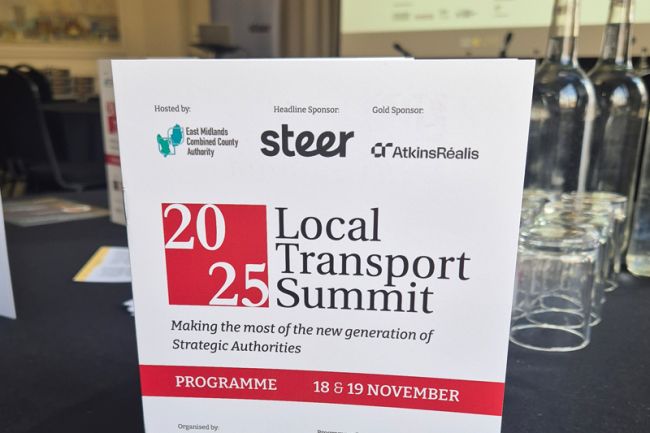
    What did we learn at the Local Transport Summit 2025?

    Simon Statham
    Director
    Nicola Kane
    Director

    Human-centred decision-making is shaping the future of local transport – here’s what we learned at the 2025 Summit.

    Read more

  • taxis
    24 Nov 2025
    Article

    Dynamic pricing: How can European cities adapt to this innovation in taxi fare setting?

    Susmita Das
    Susmita Das
    Associate

    How flexible fare models enhance performance and transparency for a more sustainable taxi system.

    Read more

  • 14 Nov 2025
    Article

    Britain’s rail stations: The ring of confidence

    Profile image
    Mike Goggin
    Managing Director, Transformation & Growth

    Exploring how greater industry confidence can shape stronger, more successful stations for 2035.

    Read more

  • 22 Oct 2025
    Article

    Game Changers: The megatrends that will redefine global infrastructure

    Jon Peters
    Associate Director

    Our latest global insight report exploring the forces transforming how we move, power, and connect the world.

    Read more

  • 24 Sep 2025
    Article

    Steer brings ninth annual Local Transport Summit to the East Midlands

    By Steer

    Steer is proud to sponsor the 2025 Local Transport Summit in Derby, driving vital discussions on devolution and future transport.

    Read more

  • 18 Sep 2025
    Article

    Ancoats Mobility Hub: Enabling car-lite developments

    By Steer

    Steer supported the UK’s first purpose-built Mobility Hub with commercial modelling to enable sustainable, car-lite regeneration.

    Read more