Article

Changes in the provision of international and domestic coach services

Moves to deregulate at EU level have triggered changes in the provision of international and domestic coach services.

By Steer

Moves to deregulate at EU level and in a number of Member States have triggered changes in the provision of international and domestic coach services. Regulation 1073/2009/EC, which came into force in December 2011, clarified and simplified the rules related to international services. In parallel, a number of Member States have liberalised the provision of domestic services, including Germany, from January 2013, and France, from August 2015.

The coach industry lends itself to starting small, sometimes with a single coach offering daily round trips between cities 6-10 hours apart, and building a network by gradually adding links to other cities. Lux Express, established in Estonia in 1993, has built up an extensive network which now serves over 50 destinations in central and eastern Europe extending nearly 2,500 kilometres from Helsinki to Budapest.

Within two years of German market opening, the largest new operators, Flixbus and MeinFernbus, had merged and have now built a network extending to Spain and London. In June 2016 they agreed to buy Stagecoach’s Megabus Europe business, further increase the scale of their operations. 
Coach services

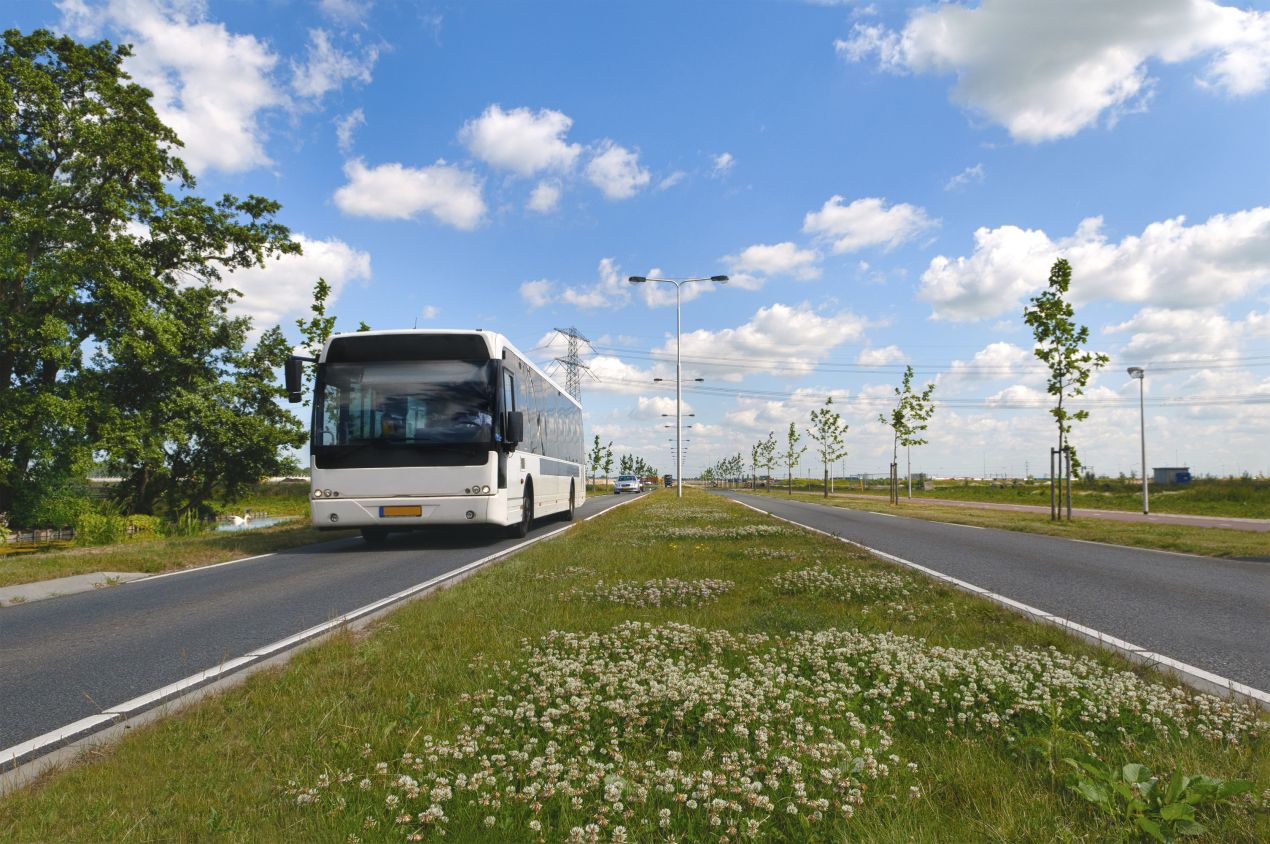
While not as frequent or fast as many rail services, some of which operate on expensive high speed lines, coaches can attract passengers willing to accept a longer journey time and can often allow them to carry large amounts of baggage. In central and eastern Europe, in contrast, rail services may be slower and less frequent, and coach is positioned as the “premium” mode, charging higher fares for fast motorway connections and on-board services including toilet, drinks, seatback video and WiFi.

Coaches require no special infrastructure, and even the extent to which terminals exist and are used by them varies widely. In some cities, coaches are allowed to use the local railway or bus station, where space permits, but in others dedicated coach terminals have been built. Rapid expansion of services has, however, often exhausted the available capacity, preventing new entry unless operators are permitted, and willing, to load and unload at shopping centres, at bus stops, or elsewhere on street.

The effect of these new services on the railways has yet to be seen. Studies in Germany show not only that coach fares are often half those of rail, but also that half of coach passengers come from rail. Where this happens, they add no net revenue to the transport industry but may increase the losses of rail services supported by a Public Service Contract (PSC). This also illustrates the inconsistencies of regulating transport by mode, rather than by market, as rail PSCs in many Member States are protected from new entry by rail but not by coach or air.

A further issue is that deregulation makes it harder to monitor the market, because of gaps in how the Member States collect and report statistics. These are often based on drivers’ counts of those on board at the start of the journey, rather than a more accurate measure of the distance each passenger travelled. Some Member States estimate coach travel within their boundaries, others report coach travel on their operators, and many have little or no information on passengers who cross their territory without leaving the vehicle.
Off

Subscribe to our newsletter, The Edit

We are Steer

Yes, you are in the right place. After 40 years, we have changed our name from Steer Davies Gleave to mark our growing international footprint and our expanding portfolio into sectors beyond transport.

Explore our new website to learn more about Steer: who we are, how we work and what our future holds.

Related insights

  • 30 Jan 2026
    Article

    Connected autonomous vehicles: What next for the UK?

    By Steer

    Bhavin Makwana reflects on the state of Connected and Automated Mobility in the UK and its implications for the future of AVs.

    Read more

  • 19 Jan 2026
    Article

    Steer featured on the Electric Evolution podcast

    Elaine Meskhi
    Principal Consultant

    Expert insight on fair, accessible and future-ready EV charging from Steer’s contribution to the Electric Evolution podcast.

    Read more

  • 16 Jan 2026
    Article

    Building a safer road environment: practical measures to support the UK’s new Road Safety Strategy

    Dom Smith
    Dom Smith
    Associate

    Practical insight and evidence-led thinking on transport, places, and infrastructure shaping safer, fairer streets.

    Read more

  • 14 Jan 2026
    Article

    P3 Evolution: How are public-private partnerships shaping a new generation of North American infrastructure?

    Alejandro Obregon
    Associate Director

    How public-private partnerships are evolving to deliver smarter, more resilient North American infrastructure.

    Read more

  • 09 Jan 2026
    Article

    Fleet electrification, ports and aviation: Steer’s outlook on 2026 infrastructure transactions

    Jon Peters
    Associate Director

    As markets stabilise, this article explores what recent transport transactions signal for infrastructure investment in 2026.

    Read more

  • 05 Dec 2025
    Article

    Bus ridership 2024-25: How do different combined authorities fare across the UK?

    By Steer

    Bus ridership shifts revealed; discover where recovery is rising, stalling or slipping across the UK.

    Read more

  • 27 Nov 2025
    Article

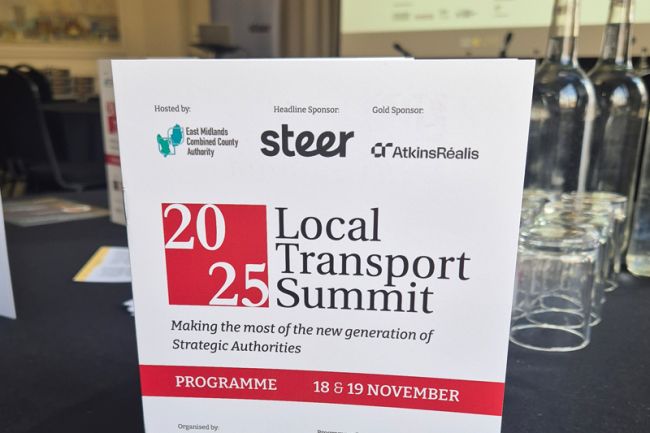
    What did we learn at the Local Transport Summit 2025?

    Simon Statham
    Director
    Nicola Kane
    Director

    Human-centred decision-making is shaping the future of local transport – here’s what we learned at the 2025 Summit.

    Read more

  • taxis
    24 Nov 2025
    Article

    Dynamic pricing: How can European cities adapt to this innovation in taxi fare setting?

    Susmita Das
    Susmita Das
    Associate

    How flexible fare models enhance performance and transparency for a more sustainable taxi system.

    Read more

  • 14 Nov 2025
    Article

    Britain’s rail stations: The ring of confidence

    Profile image
    Mike Goggin
    Managing Director, Transformation & Growth

    Exploring how greater industry confidence can shape stronger, more successful stations for 2035.

    Read more

  • 22 Oct 2025
    Article

    Game Changers: The megatrends that will redefine global infrastructure

    Jon Peters
    Associate Director

    Our latest global insight report exploring the forces transforming how we move, power, and connect the world.

    Read more

  • 24 Sep 2025
    Article

    Steer brings ninth annual Local Transport Summit to the East Midlands

    By Steer

    Steer is proud to sponsor the 2025 Local Transport Summit in Derby, driving vital discussions on devolution and future transport.

    Read more

  • 18 Sep 2025
    Article

    Ancoats Mobility Hub: Enabling car-lite developments

    By Steer

    Steer supported the UK’s first purpose-built Mobility Hub with commercial modelling to enable sustainable, car-lite regeneration.

    Read more